Spaced Repetition for German: Why It Works and How to Actually Use It
You've probably heard that spaced repetition is the best way to memorize vocabulary. And it is. But most German learners either use it wrong, set it up badly, or give up after a week because their review queue spirals out of control.
Here's how spaced repetition actually works, what the science says, and how to build a system you'll stick with.
The science in 60 seconds
Your brain forgets things on a predictable curve. Hermann Ebbinghaus discovered this in 1885 and it's been replicated hundreds of times since.
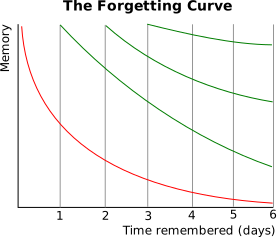
When you learn a new word:
- After 1 hour: you've forgotten ~50%
- After 1 day: you've forgotten ~70%
- After 1 week: you've forgotten ~90%
But if you review at the right moment — just before you forget — something interesting happens. The memory gets stronger, and the next forgetting curve is slower.
Review a word 5 times at the right intervals and it's essentially permanent. That's the core insight: timing your reviews is more important than how many times you review.
How SM-2 works (the algorithm behind most SRS tools)
The SM-2 algorithm, developed by Piotr Wozniak in 1987, is what powers most spaced repetition systems — including Anki and Praegen.
Here's the simplified version:
- You see a flashcard and rate how well you knew it (easy, good, hard, forgot)
- Based on your rating, the algorithm schedules the next review:
- Forgot → review again tomorrow
- Hard → review in 2-3 days
- Good → review in 1-2 weeks (increases each time)
- Easy → review in 3-4 weeks (increases each time)
- Each successful review pushes the next interval further out
- Each failure resets the interval back to short
After a few successful reviews, you might see a word at intervals of: 1 day → 3 days → 7 days → 16 days → 35 days → 90 days. By the time you're reviewing something every 90 days, it's in your long-term memory.
What most people get wrong
Mistake 1: Adding too many cards at once
This is the number one killer. You download a deck of 2,000 German words and set "new cards per day" to 50. Within a week, your daily review queue is 200+ cards and growing. Within two weeks, you dread opening the app.
Fix: 5-10 new words per day is plenty. That's 150-300 new words per month — and because you're reviewing them properly, you'll actually remember all of them.
Mistake 2: Cards without context
A flashcard that says "Bescheid → notification" is almost useless. You'll recognize it on the flashcard and fail to recognize it in a sentence.
Fix: Every card needs context. The sentence you found it in. The grammar (der Bescheid, die Bescheide). Common phrases (Bescheid geben, Bescheid wissen). The more connections your brain has, the more likely the word sticks. (More on this in How to Actually Remember German Vocabulary.)
Mistake 3: Reviewing without reading
Spaced repetition is a retention tool, not a learning tool. If the only place you encounter German words is flashcards, you're missing 90% of the learning process.
Fix: Read first, review second. Your flashcards should contain words you encountered while reading German. That way, every card already has a real memory attached — the article you read, the sentence you saw, the moment you looked it up.
Mistake 4: Skipping days and letting reviews pile up
Miss three days and suddenly you have 150 reviews waiting. That feels overwhelming, so you skip another day. The pile grows. Eventually you declare SRS bankruptcy and start over.
Fix: Do your reviews every single day, even if it's just 5 minutes. A short session every day beats a long session once a week. If reviews do pile up, don't try to clear the backlog in one sitting — just do 50-70 per day until you're caught up.
The ideal SRS workflow for German
Here's what actually works for intermediate German learners:
Daily reading (10-15 min): Read one article in German at your level. Look up 3-5 words that block comprehension or appear repeatedly. Save them with full context.
Daily review (5-10 min): Review whatever cards are due. Rate honestly — if you didn't know it, mark it as forgotten. The algorithm needs honest input to work.
Weekly check (2 min): Glance at your stats. Are you adding more cards than you can review? Cut back on new cards. Is your retention rate below 80%? Your cards might need better context.
That's 15-25 minutes per day. Over a month:
- ~100-150 new words added from real reading
- ~85-90% retained long-term
- Vocabulary that you actually recognize in conversation and text
SRS tools compared
| Anki | Praegen | Quizlet | |
|---|---|---|---|
| Algorithm | SM-2 (configurable) | SM-2 | Basic SRS |
| Card creation | Manual | Automatic from reading | Manual |
| Context included | Only if you add it | AI-generated (grammar, examples, tips) | Only if you add it |
| Reading integration | None | Built-in articles | None |
| Price | Free (desktop) | Free tier / premium | Free tier / premium |
| Setup time | Hours | Minutes | Minutes |
The biggest difference isn't the algorithm — SM-2 works the same everywhere. The difference is how cards get created and what information they contain.
In Anki, you build every card yourself. That gives you full control but it's slow and most people create thin cards (word → translation) because making rich cards takes effort.
In Praegen, cards are created automatically when you look up words while reading. Each card includes the article, gender, plural, example sentences, grammar notes, and a memory tip — all generated by AI. The context is built in because the word came from an article you were reading.
How long until it works?
Honest timeline:
- Week 1-2: You're building the habit. Reviews are quick because you haven't added many cards yet.
- Week 3-4: Review queue grows to 30-50 cards per day. This is where most people quit. Push through — it stabilizes.
- Month 2: You start recognizing words "in the wild" — in articles, conversations, signs. This is the first payoff.
- Month 3-4: Your review queue stabilizes as older cards space out to monthly intervals. Daily reviews take 5-7 minutes.
- Month 6+: You've added 500-800 words that you genuinely know. Reading gets noticeably easier. Conversations feel less like a puzzle.
The bottom line
Spaced repetition works. The science is clear. But the implementation matters more than the algorithm.
Keep it simple: read every day, save 3-5 words, review what's due. Don't over-optimize. Don't add 50 cards at once. Don't skip review days.
The compound effect of consistent daily practice is more powerful than any algorithm tweak.